
Where is Sam Damon?

A blog dedicated to debate and commentary on national security, foreign affairs, veterans' issues, and a whole host of other topics. If you are not familiar with who Sam Damon is, click here. Feel free to post comments or contact Onager via e-mail at whereissamdamon@gmail.com.
Thursday, September 22, 2011


Defense Dept. needs to change spending culture
This is something that I have been talking about for over three years on this blog. Unfortunately when he ran for president in 2008, Sen. McCain didn't describe the DoD culture as a "culture that has allowed massive waste of taxpayers’ dollars," as he did last Tuesday during a meeting of the Senate Armed Services Committee.
Monday, September 19, 2011
Sunday, September 18, 2011
Defense spending must have credit limits
Pace at the hearing put forward a stunning fact we should remember: “Less than 1 percent of the nation has been defending the other 99 percent for 10 years.” McKeon on Monday picked up that thought with a slightly different twist: Since Sept. 11, 2001, he said, “the majority of Americans have lived without being touched by the horrors of conflict. We are at the mall while Marines are in the mud.” Only Rep. Jim Cooper (D-Tenn.) called the committee’s attention to the fact that Afghanistan and Iraq are “the first wars in American history that we didn’t even try to pay for. There was no war tax. There were no war bonds. . . . Instead, we borrowed the money from China and other foreign nations.” We are still borrowing for our defense and not paying for it. Maybe it’s time for the parent to take back that credit card.
Sikorsky Grew With America's Two Long Wars
At least Blackhawks are used in the current wars... the majority of the R&D money the Air Force hands out surely isn't.
Wednesday, September 7, 2011
“For the Taliban, Islam is about propaganda... For us, it’s about faith.”
In recent years, the army has recruited 50 men known as hafiz — those who have memorized the Koran — in addition to dozens of clerics. Those officials work to ensure that Islamic law is observed within the ranks and that the intensity of the war doesn’t overwhelm soldiers’ religious obligations. The army’s cadre of spiritual leaders, most of whom carry religious texts, not weapons, are also meant to send a message to Afghan civilians, as walking symbols of the military’s faith.
Tuesday, September 6, 2011
U.S. to drop troop levels to 3,000 in Iraq
It is about time. If we limit our mission there to training only, then I believe they will get the picture: that they are in charge of their own destiny.
In Iraq, a new breed of returning exile
What are we going to do? Turkey is in NATO and hates the Kurds, yet the Kurds have been our most consistent ally in Iraq.
See previous posts:
Support the Kurds
Tensions stoked between Iraqi Kurds and Sunnis
A Turning Point?
After the U.S. invasion in 2003, Kurds who had been expelled by Hussein and replaced by Arab families returned by the thousands, hoping to reclaim their lost homes. Disputes over land rights are common, and many are still homeless. Soldiers from all three ethnic groups help keep the peace — and sometimes end up in tense standoffs themselves.
Over it all hangs the central question: Should Kirkuk remain part of Iraq proper or be governed by the semiautonomous region of Kurdistan to its north? Plans for a census to determine who lives in Kirkuk and a referendum to decide its governance, promised by the Iraqi constitution, have stalled.
See previous posts:
Support the Kurds
Tensions stoked between Iraqi Kurds and Sunnis
A Turning Point?
Monday, September 5, 2011
Americans live in an era of endless war
War should not be normal. It should be an aberration, a black mark on the world, something that is rare and exemplifies the complete breakdown of how a society should solve problems. However, for Americans, it is not.
Read the article. Americans shouldn't accept living in an era of endless war.
The long stretch of war has also isolated the U.S. military from society. Senior Army officials worry that career soldiers have forgotten how to take care of their troops outside the war zones. A 2010 Army study partially blamed the service’s unusually high suicide rate on the “lost art of leadership in garrison.”Why shouldn't the troops feel that they are better than the society they serve? This nation has been at war for 10 years and less than one percent of Americans have served in those wars. The veterans that do leave the service before military retirement can't even find a job and have to start from scratch in building a new career because corporate America doesn't recognize the skills they have gained through military service. The career servicemembers that retire end up working for defense contractors that keep them in the "military bubble" isolated from society, perpetuating war by building more powerful weapons and equipment with 435 different parts manufactured in each congressional district in the nation. It is a sad state of affairs.
Other top military officials fret that the troops are developing a troubling sense that they are better than the society they serve.
Read the article. Americans shouldn't accept living in an era of endless war.
Monday, August 29, 2011
Kucinich: Libyan foray represents ‘new international gangsterism’
The War Powers Act should not be violated. Period.
Rep. Dennis Kucinich (D-Ohio) said the five-month-old intervention — now being led by NATO — sets a dangerous precedent for unilateral attacks on sovereign nations. He said Western forces “illegally” picked favorites in Libya’s civil war, and he called on the International Criminal Court to investigate potential war crimes by military leaders on all sides of the conflict . . . “Now that NATO, with the help of the U.S., has brought the rebels into the streets of Tripoli to fight, what follows? What’s the plan?”
Clearly, this never went anywhere:
Put War Powers Back Where They Belong
Suicide Bomb Kills Dozens In Baghdad's Largest Sunni Mosque
Hopefully, we aren't going to be in Iraq for this edition of the Sunni-Shiite Civil War...
See previous posts:
Violence highlights fears of Iraqi security forces taking over after U.S. leaves
Shiites in Iraq Show Restraint as Sunnis Keep Attacking
Shiite Control Raises Tensions with Sunni Groups
For U.S. and Sunni Allies, a Turning Point
See previous posts:
Violence highlights fears of Iraqi security forces taking over after U.S. leaves
Shiites in Iraq Show Restraint as Sunnis Keep Attacking
Shiite Control Raises Tensions with Sunni Groups
For U.S. and Sunni Allies, a Turning Point
Wednesday, August 24, 2011
Tuesday, August 23, 2011
Why the United States will lose a Cyber War
Unfortunately for Western nations, synchronicity has its origins in the East. Western nations have a tradition in causality, not synchronicity. And the U.S. Defense Department is deeply grounded in traditional western thinking and practicality. The decision to call cyberspace a domain was based on organizational necessity. That’s how the Defence Department is set up. It’s how budgets are created and funds distributed. It’s how contracts get assigned. Simply put, it’s how things get done at the Pentagon. This is why the United States will lose a war fought in cyberspace. A strategic doctrine built upon a flawed vision can’t yield a victory against an adversary whose knowledge of the battle space is superior to our own.
Monday, August 22, 2011
Want to cut big government abuses? Start with defense contracting
One US government contractor, Anham, is making millions off the Iraq war, allegedly charging US taxpayers $4,500 for a circuit breaker that costs only $183 at an appliance store, $3,000 for a separate circuit breaker that costs $94, and $900 for a control switch that costs $7. The contractor has issued a statement denying the charges of overbilling; the issue, in any case, is not limited to one contractor. DynCorp was also fingered by SIGIR for inflating claims for the construction of container camps. Thankfully, SIGIR is reclaiming $7.7m from the company and another $1m from its subcontractor, the Sandi Group.
That defence contractors are making a killing out of the war in Iraq, or for that matter, Afghanistan, Libya, Pakistan, Somalia, Yemen, etc) is hardly news.
Sunday, August 21, 2011
America's sentimental regard for the military
The military is can-do, the one institution — certainly the one public institution — that still appears to work. The schools, the highways, the post office; Amtrak, FEMA, NASA and the T.S.A. — not to mention the banks, the newspapers, the health care system, and above all, Congress: nothing seems to function anymore, except the armed forces. They’re like our national football team — and undisputed champs, to boot — the one remaining sign of American greatness . . .
“America needs heroes,” it is sometimes said, a phrase that’s often uttered in a wistful tone, almost cooingly, as if we were talking about a lonely child. But do we really “need heroes”? We need leaders, who marshal us to the muddle. We need role models, who show us how to deal with it. But what we really need are citizens, who refuse to infantilize themselves with talk of heroes and put their shoulders to the public wheel instead. The political scientist Jonathan Weiler sees the cult of the uniform as a kind of citizenship-by-proxy. Soldiers and cops and firefighters, he argues, embody a notion of public service to which the rest of us are now no more than spectators. What we really need, in other words, is a swift kick in the pants.
Saturday, August 20, 2011
Britain's last war?
Since the Cold War’s end, the combined GDP of NATO’s European members has grown 55 percent, yet their defense spending has declined almost 20 percent. Twenty years ago, those nations provided 33 percent of the alliance’s defense spending; today, they provide 21 percent.
This is why Robert Gates, before resigning as US defense secretary, warned that unless Europe’s disarmament is reversed, future US leaders “may not consider the return on America’s investment in NATO worth the cost.” Born to counter the Soviet army on the plains of Northern Europe, NATO may be expiring in North Africa.
Wanted: A good job and some understanding
Spectacular article. Sums up exactly the way I felt when I left active duty.
Friday, August 12, 2011
Pentagon loses its hypersonic jet on test
How much does this program cost? Don't we have first-strike capability with nuclear submarines?
Wednesday, June 8, 2011
Iraq's Chalabi, who sought invasion, now wants U.S. out
Thank you, McClatchy, for continuing to cover Iraq. Remember, since combat operations in Iraq have been declared over there have been 36 U.S. servicemembers killed.
Also, thanks for nothing, Mr. Chalabi, for lying to us in 2002-2003 and helping us decide to invade Iraq in 2003.
Here is a quote from the article:
Also, thanks for nothing, Mr. Chalabi, for lying to us in 2002-2003 and helping us decide to invade Iraq in 2003.
Here is a quote from the article:
Still, there is, if nothing else, an irony in Chalabi's avowed opposition to asking the Americans to stay longer. It was Chalabi's Iraqi National Congress that provided much of the false information, including allegations that Saddam was developing weapons of mass destruction and had ties to al Qaida, that the Bush administration used to justify the 2003 invasion. Nearly all of the information the INC provided turned out to be untrue.
Monday, May 30, 2011
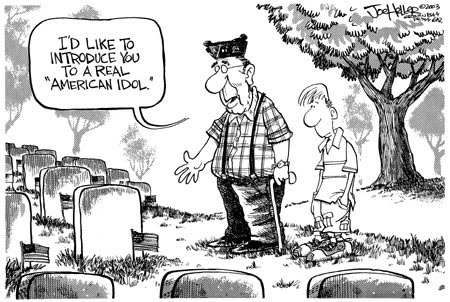
Tuesday, May 24, 2011
DADT: A young, gay officer witnesses its end
This is going to be a must read blog. I hope the implementation of this policy goes better than the implementation of other policies...
Tuesday, May 17, 2011
Strain on forces in the field at a five-year high
A quote from the article:
"We're an Army that's in uncharted territory here," says Gen. Peter Chiarelli, Army vice chief of staff, who has focused on combat stress. "We have never fought for this long with an all-volunteer force that's 1% of the population."And we are talking about cutting end-strength? That means the Soldiers we have will have to deploy even more often.
Mental health strain was most severe among veterans of three or more deployments, with a third of those showing signs of psychological problems defined as either stress, depression or anxiety, the report obtained by USA TODAY says.
Monday, May 16, 2011
Challenges await GEN Dempsey
 GEN Dempsey needs to fight with the Obama administration to keep the end-strength of the Army at its current levels. Remember GEN(R) Shinseki's warning of fighting two wars without enough troops in 2003? He has been proven correct. The 1:1 deployment cycle - one year deployed, one year "at home" (which ends up being 6 months because you are in the field for 6 months) - has proven debilitating. Ironically, GEN(R) Shinseki is dealing with the effects of the 1:1 deployment cycle as the head of the VA now.
Young officers have left the service in droves, the divorce rate is through the roof, and mental health issues run rampant across the ranks (at rates undoubtedly higher than the reported rates). It has taken the Army almost ten years to add end-strength and now we are talking about cutting it, while claiming that we are moving towards a 1:3 deployment cycle? In addition, end-strength is not very costly - it is costly to build up and train new leaders, but not that expensive to maintain - especially given the goal of a 1:3 deployment cycle.
The DoD cuts should come from weapons programs, not from the end-strength of the Army or Marines. The Army is not a service that needs cutting-edge weapons programs to justify its existence... it needs well-trained, battle-tested leaders in its ranks (which it has now), so that it can fight and win America's wars. People are the Army's most valuable asset, not expensive weapons programs. Just as the Air Force fights for every R&D dime, GEN Dempsey needs to fight cuts to the Army's end-strength.
Wednesday, May 11, 2011
Thursday, May 5, 2011
Division in Iraqi Kurdistan
But Kurdistanis between the ages of 15 and 30 -- approximately 40% of the population -- grew up in an already semi-autonomous Kurdistan. Most of them only heard about the struggle against the former regime from their parents and grandparents.
They did, however, witness the armed struggle for power between the KDP and the PUK from 1994 to 1997, and have lived under two-party rule that dominates political representation, resource management and access to employment. They have little or no contact with the rest of Iraq, attend Kurdish universities, speak Kurdish better than Arabic -- and hold Irbil politically accountable before Baghdad.
In the eyes of this youth, the KDP and PUK have spent the past 20 years prioritizing parochial interests over the national good.
Until the protests started, the Kurdistan Regional Government (KRG) ministries remained split between the two parties -- with no access for others -- and little collaboration has existed between them. Peshmerga forces, long the symbol of national resistance to Hussein's regime, are also divided into two uncooperative branches, one loyal to the KDP and the other to the PUK.
Furthermore, although Kurdistan enjoys better security than the rest of Iraq and has seen investments pour in since 2003, between 35% and 45% of Kurdish youth remain unemployed or underemployed. Political affiliation often regulates advancement.
Tuesday, May 3, 2011
Monday, May 2, 2011
Careful preparation, rather than expensive weapons, took out Osama Bin Laden
Emotionally, the Bush administration—and the country—felt the need for a major military response after the attack on the World Trade Center and the Pentagon. But although Iraq may still come right in the end, was it the best use of our money and resources? Afghanistan may eventually become stable—but haven't we just learned, if we didn't know it already, that the real and more complicated threat now comes from Pakistan? In 2008, the U.S. ambassador to Kabul told me, in effect, that Pakistan was none of his business. Perhaps it should have been.Are you kidding me William Braucher Wood? Pakistan was none of your business? No wonder it took almost 10 years to get bin Laden. I bet Ronald Neumann, ambassador from 2005 to 2007, felt the same way.

Sunday, May 1, 2011
How the Soviets withdrew from Afghanistan
Throughout the occupation, Soviet leaders launched a series of initiatives aimed at helping their Afghan allies stand on their own feet — to gain domestic and international legitimacy and to develop the wherewithal to fight off insurgent campaigns. This would in turn allow the Soviets to withdraw honorably. Each effort was announced with great fanfare, implemented and eventually found wanting.
Years of economic and development aid — employing thousands of Soviet specialists and costing billions of rubles — were found to have been largely wasted because of poor planning and corruption, and programs were pared back. The advisers the Soviet Union had placed at every level of the Afghan government, military and ruling party were doing the Afghans’ work for them, rather than developing competent and independent bureaucratic cadres, and Gorbachev withdrew them. Ambassadors were changed, generals shuffled, military strategies adjusted. Special forces were used with increasing frequency, and there was an effort to push the Afghan military into taking a more prominent role in operations — an effort made more difficult because Soviet officers often didn’t trust the Afghans.
Saturday, April 30, 2011
Vickers
 What a remarkable career. At least now I know who the smart former Green Beret from Charlie Wilson's War is...
Friday, April 29, 2011
A new national security team
Here are some quick comments on the national security moves:
It appears clear to me that Ryan Crocker will be an upgrade over Karl Eikenberry as ambassador to Afghanistan.
As to the other moves, in my mind, Secretary Gates is the finest Secretary of Defense in our history. Mr. Panetta, although talented, probably won't come close to Secretary Gates. Secretary Gates has been fighting the DoD bureaucracy since the beginning of his tenure asking for budget cuts and to spend money on "stuff" we need now, not 20 years from now; he was a visionary. Mr. Panetta, a Washington insider, is not a visionary.
With regards to the GEN Petraeus move, it seems like a lateral move that just allows him to collect his Army retirement check and a paycheck for being CIA Director, while keeping him in the United States with his family (most of the time). This move also keeps him off the ballot, an added benefit to career politicians that view him as a potential threat.
Finally, Lt. Gen. Allen will do a fine job in Afghanistan if his work in Iraq's MNF-W is any indicator.
Here is an excerpt from the article:
It appears clear to me that Ryan Crocker will be an upgrade over Karl Eikenberry as ambassador to Afghanistan.
As to the other moves, in my mind, Secretary Gates is the finest Secretary of Defense in our history. Mr. Panetta, although talented, probably won't come close to Secretary Gates. Secretary Gates has been fighting the DoD bureaucracy since the beginning of his tenure asking for budget cuts and to spend money on "stuff" we need now, not 20 years from now; he was a visionary. Mr. Panetta, a Washington insider, is not a visionary.
With regards to the GEN Petraeus move, it seems like a lateral move that just allows him to collect his Army retirement check and a paycheck for being CIA Director, while keeping him in the United States with his family (most of the time). This move also keeps him off the ballot, an added benefit to career politicians that view him as a potential threat.
Finally, Lt. Gen. Allen will do a fine job in Afghanistan if his work in Iraq's MNF-W is any indicator.
Here is an excerpt from the article:
Perhaps the greatest risk of the reshuffle comes in Afghanistan, where the departure of Gen. Petraeus will remove America’s most skilled military commander from a campaign that appears to be teetering between success and failure. Lt. Gen. Allen, however, was a key contributor to the successful turnaround of the war in Iraq; and Mr. Crocker offers a major improvement over his predecessor, Karl Eikenberry, who contributed substantially to the souring of U.S. relations with Afghan President Hamid Karzai.
Thursday, April 21, 2011
President Obama's Defense Cuts
I still think that the last thing that should be cut from the DoD budget is manpower. It takes years to build. We can quickly build more planes, bombs, and tanks, but we can't quickly build up end-strength. Unfortunately, both Secretary Gates, who I agree with frequently, and President Obama, feel otherwise. We have a force that is tired and weary; cutting 40,000 of them will only make them more tired as we ask them to do even more.
Wednesday, April 20, 2011
Army chief of staff visits Soldiers in Iraq
"We're promoting 95 to 98 percent of captains to major, 93 or 95 percent of majors to lieutenant colonel," said Martin. "We're not really separating out the true high performers that we should aspire to have. We shouldn't be satisfied that 98 percent of captains are being promoted to major, because 98 percent of captains don't deserve to be promoted to major. Statistically, that's an infeasible percentage. And we've got to do the same thing on the noncommissioned officer side."
Sunday, April 10, 2011
GEN Petraeus to CIA Director?
I don't quite understand this one... if GEN Petraeus ultimately wants the job of Secretary of Defense, why not just give it to him it when Secretary Gates (pbuh) resigns? Maybe his peer flag officers wouldn't like that? Boo hoo hoo.
Saturday, April 9, 2011
Clay Hunt
"He thought the world was supposed to be a better place than it is, and he lived every day of his life thinking, perhaps naively, that his efforts could make the world be what he thought it should be," Wood said.
When Hunt woke up every day and his efforts seemed in vain, that made him more depressed, Wood said.
Tuesday, March 29, 2011
Wars Emerge as 2012 Issue
How can THREE wars NOT be an issue during an election? I guess it is conceivable when less than one percent of the population - the battle slaves - are fighting them.
Monday, March 21, 2011
GEN Carter Ham
I'm happy to see that he could seek help. The question is can lower ranking Officers and NCOs successfully do the same and keep their careers?
Wednesday, March 16, 2011
Best and Brightest
One would think that the Army should do everything in its power to keep the best and brightest in its Officer Corps, but apparently we can settle for the "less-than best and brightest," to use GEN Kroesen's words, and do an ok job. I'm sure that is exactly what the FORTUNE 100 companies and top law firms think of losing hot-shot associates, right? No. We need to view losing such talent as a win for the "enemy" not think like GEN Kroesen and say to ourselves, "Oh, ho hum, the Army keeps rolling along."
Tuesday, February 8, 2011
Monday, January 31, 2011

Tuesday, January 25, 2011
Sunday, January 23, 2011
Discrepancy in religious beliefs of troops, chaplains
This is a serious problem in the military today. One of the things that was especially annoying were the prayer breakfasts that every commander basically had to attend if the brigade commander was an evangelical Christian. It is quite sad that the Chaplain Corps does not mirror the makeup of the military today.
I also think it is awful that many mainline Protestant and Roman Catholic leaders don't encourage their clergy to join the military. Barring the military from seminaries is awful, just as barring ROTC from universities has been awful; all it does is lower the quality of the Officer Corps and lead to the further detachment of the military from general society.
I also think it is awful that many mainline Protestant and Roman Catholic leaders don't encourage their clergy to join the military. Barring the military from seminaries is awful, just as barring ROTC from universities has been awful; all it does is lower the quality of the Officer Corps and lead to the further detachment of the military from general society.
Saturday, January 8, 2011

Wednesday, January 5, 2011

Monday, January 3, 2011

Sunday, January 2, 2011
In large numbers, and with few rules, retiring generals are taking lucrative defense-firm jobs
This is something I have been harping about for more than two years on this blog...

Subscribe to:
Posts (Atom)